
Waste not want not: Sweden to give tax breaks for repairs


Government to tackle ‘throwaway culture’ by cutting VAT on fixing everything from bicycles to washing machines
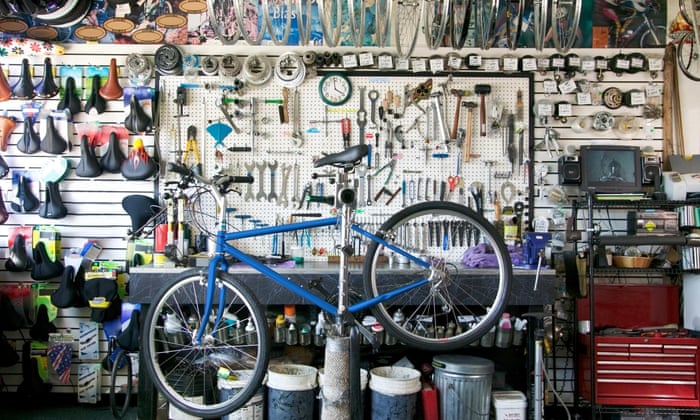


The Swedish government is introducing tax breaks on repairs to everything from bicycles to washing machines so it will no longer make sense to throw out old or broken items and buy new ones.
Sweden’s ruling Social Democrat and Green party coalition is set to submit proposals to parliament  to slash the VAT rate on repairs to bicycles, clothes and shoes from 25% to 12%.
It will also submit a proposal that would allow people to claim back from income tax half of the labour cost on repairs to appliances such as fridges, ovens, dishwashers and washing machines.
“We believe that this could substantially lower the cost and so make it more rational economic behaviour to repair your goods,” said Per Bolund, Sweden’s minister for financial markets and consumer affairs and one of six Green party cabinet members.


He hopes the tax break on appliances will spur the creation of a new home-repairs service industry, providing much-needed jobs for new immigrants who lack formal education.
The incentives are part of a shift in government focus from reducing carbon emissions produced domestically to reducing emissions tied to goods produced elsewhere.
Sweden has cut its annual emissions of carbon dioxide by 23% since 1990 and already generates more than half of its electricity from renewable sources.
“I believe there is a shift in view in Sweden at the moment. There is an increased knowledge that we need to make our things last longer in order to reduce materials’ consumption,” he said.
The proposals will be presented in parliament as part of the government’s budget proposals and if voted through in December will become law from 1 January 2017.


Comments

Popular posts from this blog

Sanjay Leela Bhansali distorting history

Mr Sanjay Leela Bhansali if I make a movie a decade later showing this accomplished director was a drug addict and used to beat his co actors on sets of course with a disclaimer that  this movie is a work of art and changes have been made to characters but use the name Sanjay Leela Bhansali How will you feel? Sanjay Leela Bhansali was born in the year 1963 in Mumbai. He was a student of Film and television Institute of India, from where he was thrown out after a spat with the institute’s director.  Bhansali is also the only filmmaker who couldn’t be bothered with authenticity, accuracy and other such yardsticks when it comes to creating cinema. Devdas He is the only filmmaker who could not only take Sarat Chandra Chattopadhyay’s much-loved parable  Devdas  and give it a saas-bahu serial makeover in the name of creative license. After all, in the dozen odd adaptations of the novel no one could come with the idea of putting Chandramukhi and Paro in t...
Slowly. Then All At Once. US Markets rising before bust? “How did you go bankrupt?” Hemingway once wrote. “Two ways. Gradually, then suddenly.” That rhythm doesn’t just describe personal ruin. It describes how entire markets, economies, even societies unravel. Right now, we’re in the gradually stage. Debt is piling up, valuations are stretched, liquidity is tightening. None of these on their own feels like a breaking point. Life goes on. Markets rally. Optimism prevails. But history teaches us that pressures build invisibly , until a tipping point forces them into the open. Think back to 2008. Subprime mortgages, reckless lending, overleveraged banks , all slow-burn problems. Then Lehman collapsed, and in a matter of weeks the global financial system looked completely different. What felt manageable for years suddenly became existential. We’re seeing similar patterns today. Government debt-to-GDP ratios are at record highs. Small and mid-cap stocks in India are trading at valuat...

Mr Vajpayee: A diamond lost in shine India campaign

In the early 2000s, India had witnessed steady economic growth under Vajpayee, and BJP in general had become synonymous with progress due to reforms, infrastructure including Golden Quadrilateral  Development oriented Vajpayee took over PM Office in 1998, one of his first major announcements was the 6000km highway project called “Golden Quadrilateral” which intended to connect most of the major industrial, agricultural & cultural centres of India, including the 4 metro cities. Over the next 5 years, Vajpayee’s govt added almost 25,000km of national highways which was the highest ever in a 5 year timeframe since independence which kickstarted economic prosperity. The rate of economic growth in 2003, a few months before the UPA came to power, was at 7.9%. The rate of inflation was at 3.8%. In fact, the rate of inflation during the entire NDA term averaged at 4.8%, The 2004 Lok Sabha results did surprise many people , journalists and even the Congress party considering t...